Can Your Roof Carry an Oklahoma Ice Storm?
Anyone who lived in Bartlesville in December 2007 remembers the sound before the sight. Branches cracked all night like rifle shots, followed by the dull thud of whole limbs landing on rooftops, cars and fences. Freezing rain fell over northeast Oklahoma for more than a day and a half, and the National Weather Service office in Tulsa later called it possibly the costliest ice storm in the state’s history. More than 200,000 homes in the region lost power, some of them for days.
Ice gets far less attention than hail around here, and that is exactly why it catches people off guard. Hail announces itself in a few loud minutes. Ice works through weight and patience. When homeowners from Dewey down to Owasso call Mission Roofing after a hard freeze, the problem is rarely one dramatic hole. It is a gutter run pulled away from the house, a fascia board split along a screw line, a soffit panel nudged loose, or an old shingle field that finally gave up under a fallen limb. The Bartlesville team works on roofs, gutters, soffit and fascia, and even fencing, which happens to be a fairly accurate map of where an ice storm leaves its marks.
The most useful way to think about ice is to follow it the way it travels. It starts in the trees, lands on the shingles, collects at the roof edge and finishes its work on the ground. Each level fails in its own way, and each one can be checked in the mild weeks before winter arrives.
Trouble Begins Above the Shingles
A thin glaze looks harmless on a single twig. Spread that glaze across an entire tree, though, and a large limb can end up carrying hundreds of extra pounds. Branches that would shrug off a summer thunderstorm simply snap.
Some trees handle this better than others. Bradford pears, which line plenty of Green Country streets and backyards, are notorious for splitting at their narrow crotches. Silver maples and Siberian elms drop limbs readily too. Mature oaks tend to hold up better, although a dead branch on any tree is a liability once ice adds weight to it.
The rule of thumb is simple. If a limb could reach the roof when it falls, it deserves a closer look before December. Trimming is a job for a certified arborist rather than a roofer, and anything near a power line belongs to the utility company. A few hundred dollars spent on pruning now is far cheaper than a new section of roof decking later.
What Freezing Rain Does to a Shingle Field
A sound roof structure can usually bear the weight of glaze ice on its own. The shingles themselves are the more vulnerable part.
Asphalt turns brittle in the cold. Walking on a frozen roof, or trying to chip ice loose with a shovel or hammer, cracks shingles and tears away the protective granules. Every roofer in the region has seen more damage from well meaning homeowners than from the ice they were trying to remove. Leave the roof alone until it thaws.
Timing matters for newer roofs as well. Shingles rely on sealant strips that bond in warm sunshine. A roof installed late in the fall may not fully seal before the first cold winds arrive, and some manufacturers call for hand sealing in cooler conditions. If your roof went on recently, it is worth asking your installer how that was handled.
Then there is the thaw. Ice on the upper slopes melts first on a sunny afternoon, runs down toward the colder eaves and refreezes overnight. Ice dams are far more common up north, yet they do form in Oklahoma, particularly on north facing slopes and low pitch porch roofs. Water trapped behind that ridge of ice can creep back under the shingles. Whether an ice and water barrier is required at the eaves depends on local code, but requesting one along the eaves and in the valleys during a reroof costs little compared to what it prevents.
Where the Edge Takes the Hardest Hit
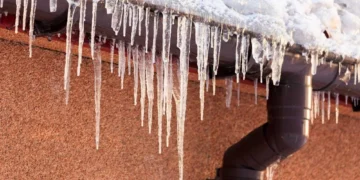
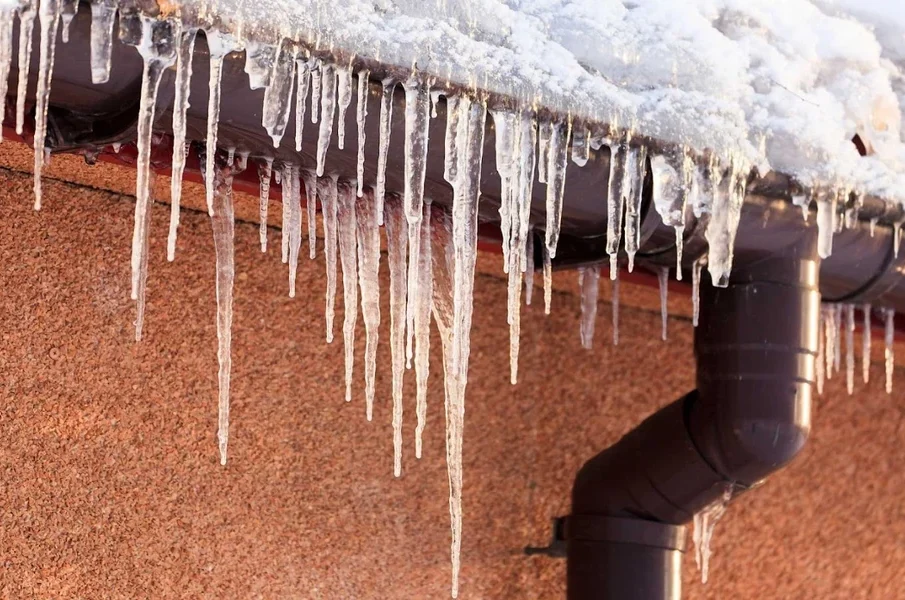
Most ice storm repairs happen at the roof edge, and fall is the reason. Oak leaves, pine needles and maple seeds pile into the gutters through October and November. When freezing rain arrives, that debris acts like a dam, the trough fills with water and the entire run freezes solid.
A gallon of water weighs a little more than eight pounds. A long clogged gutter along the back of a house can easily hold a couple hundred pounds of ice, all of it hanging from hangers driven into a single fascia board. If that board is soft from years of minor overflow, the screws pull straight out and the gutter folds downward, sometimes taking a strip of fascia with it.
Soffit vents suffer next. Meltwater that backs up behind a frozen gutter can wick into the soffit, stain the eaves and push vinyl panels loose. Those gaps tend to become doorways for squirrels and birds by spring.
A short walk around the house from the ground will reveal most of these weak points.
- Gutters that already sag, or where water spills over the front during ordinary rain
- Fascia boards with peeling paint, dark streaks or soft spots that give under a screwdriver
- Hangers spaced far apart, especially at corners where ice loads concentrate
- Soffit panels that are wavy, gapped or stained near the gutter line
- Downspouts that empty onto driveways, steps or walkways
Clearing the gutters after the last leaves drop, rather than in early fall, makes a real difference. Tighter hanger spacing and replacing rotted fascia before winter are modest repairs that keep a frozen gutter attached to the house.
Damage That Lands on the Ground
Long icicles may look pretty, but over entry doors they are a genuine hazard, and their weight adds stress to the gutters holding them. Downspouts that discharge onto concrete create ice sheets right where people walk. Extending them a few feet into the yard solves both the slipping problem and the foundation soaking that follows each thaw.
Fences take a beating too. In 2007, plenty of backyard fences across Washington and Tulsa counties were flattened by limbs rather than by wind. A fence line under heavy branches is worth considering alongside the roof when you plan any trimming.
If damage does occur, photograph everything before cleanup begins. Insurance adjusters want to see the fallen limb on the roof, the bent gutter and the cracked fence panel as they were. Cover an opening only when it is safe to do so, and never climb onto an icy roof to place a tarp.
The Leak That Is Not Really a Leak
Some of the most puzzling winter calls involve water stains that appear after the ice is gone. Often the roof is fine. During a long cold snap, warm moist air from inside the house drifts into the attic through gaps around light fixtures, the attic hatch or bathroom fans vented into the attic instead of outdoors. That moisture freezes as frost on nail tips and the underside of the decking. On the first warm afternoon it all melts and drips onto the ceiling.
Sealing those air leaks and making sure intake and exhaust ventilation are balanced usually ends the problem. It is worth a quick look in the attic during the next cold morning, flashlight in hand, to see whether frost is forming up there.
A Mild Autumn Is Your Best Window
October and November in northeast Oklahoma tend to be generous, with dry days and comfortable afternoons that make outdoor work easy. That is the window when trimming, gutter cleaning and small edge repairs make the most sense. Once freezing rain is in the forecast, the only thing left to do is wait and listen to the trees.
The houses that come through an ice storm in good shape are rarely the ones with the newest roofs. They are the ones where someone spent an afternoon in the fall looking up, noticing the weak spots and dealing with them while the ground was still dry.



Leave a reply
You must be logged in to post a comment.